

Products to compare
An APS-C zoom and a full-frame prime on the same mount
These are compatible but fundamentally different lens choices for an APS-C EOS R body. The MPB link contains individual used RF-S 18-45mm zooms, while the Adorama link is a new RF 50mm f/1.8 prime. The links are uncommissioned. Verify the selected item, condition, contents, price, availability, and current terms.
Choose the RF-S 18-45mm only when its wider-to-normal zoom range, stabilization, and small package fit the assignment. Choose the RF 50mm only when its tighter fixed view and f/1.8 aperture solve a demonstrated need. Full-frame coverage alone does not make the RF prime a better APS-C purchase.
These links lead to product listings or manufacturer buying options. PriceChomp earns no commission from them. How our links work.
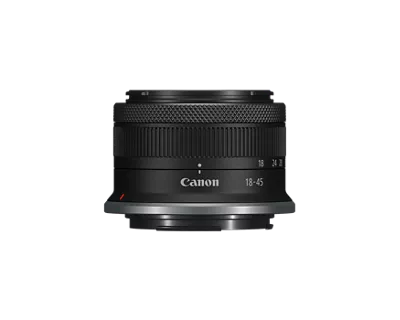
For a compact wide-to-normal APS-C range
Used Canon RF-S 18-45mm f/4.5-6.3 IS STM
APS-C-focused RF-mount 18-45mm standard zoom with optical stabilization and a variable maximum aperture.
- Why choose it
- Canon specifies an 18-45mm range, optical stabilization, and an approximate 130-gram weight. MPB lets you inspect the condition and included items for the selected used copy.
- The tradeoff
- Its maximum aperture changes from f/4.5 to f/6.3, and the long end is shorter than 50mm. Inspect stabilization, autofocus, the retracting mechanism, glass, rings, and mount.
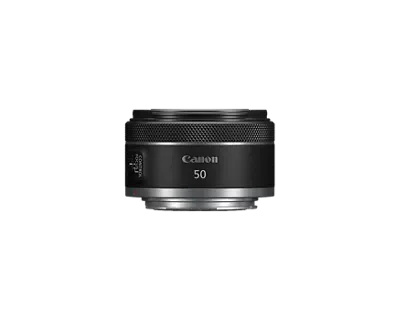
For one tighter view and a wider aperture
Canon RF50mm F1.8 STM
Canon RF-mount 50mm f/1.8 prime for EOS R cameras; covers full-frame and APS-C sensors.
- Why choose it
- Canon specifies a fixed 50mm focal length, f/1.8 maximum aperture, and approximate 160-gram weight. Adorama provides a new exact-model cart to inspect.
- The tradeoff
- It cannot produce the zoom's 18mm wide view from the same position and has no in-lens stabilization. Test the 50mm field of view and depth of field on your APS-C body.
Product details checked against the linked manufacturer and retailer pages. These are research-based comparisons, not hands-on tests. Check the selected model, current price, availability, and return terms before buying.
Start with mount compatibility, not the marketing label
Canon identifies the EOS R50 as an APS-C camera with an RF mount and lists both RF and RF-S lenses as compatible. That settles the basic physical question for this example: a compatible RF lens does not need an adapter on the R50, and an RF-S lens is not a different mount. It does not settle which lens produces the field of view, light gathering, handling, or working distance you need.
RF lenses are designed to cover the larger full-frame image area. RF-S lenses are designed around the smaller APS-C image area. On an APS-C body, the sensor records only its own smaller portion of the projected image either way. The coverage label therefore belongs near the top of the checklist, but it should not outrank the photograph.
Translate focal length into the view on your camera
The marked focal length does not change when a lens moves between compatible sensor formats. What changes is the field of view recorded by the sensor. Canon describes a 1.6x crop factor for its APS-C examples, so a 50mm lens on an APS-C body frames like a narrower view than the same 50mm lens on a full-frame body. That comparison is about field of view, not extra optical magnification.
Before shopping, stand where you will actually photograph and test the framing with a lens you already own. If you can, set a zoom to the candidate focal length. If you cannot, use a field-of-view preview or rental and verify the real subject distance. A lens can be fully compatible and still be too tight for a room, too wide for a distant subject, or wrong for the working distance you are allowed.
| Question | What to hold constant | What to record |
|---|---|---|
| Can I fit the scene? | Camera position and subject distance | The widest view that still includes the required edges |
| Can I isolate the subject? | Framing and output size | The distance and aperture that produce acceptable separation |
| Can I work from the permitted position? | Sideline, aisle, or room boundary | The focal length that fills enough of the frame |
| Can I carry it? | Body, lens, strap, bag, and duration | The complete ready-to-shoot weight and packed space |
Choose RF-S when the APS-C-focused package fits the assignment
Canon specifies the RF-S18-45mm F4.5-6.3 IS STM as an 18-45mm zoom weighing about 130 grams, with optical stabilization rated at four stops under its stated test conditions. Its wide end is useful when an APS-C body must cover interiors, everyday scenes, or self-recording distances that a 50mm lens cannot fit. The retracting design also makes the carry advantage concrete.
Those benefits do not make the lens universally better. Its maximum aperture changes through the zoom range, and its 45mm long end may not reach a distant subject. Stabilization can reduce camera-shake blur, but it does not freeze a moving subject. Choose this path when the tested view, size, and zoom range matter more than the alternative lens capability.
- Check whether the lens must be extended before shooting and whether that delay matters.
- Test the maximum aperture at the focal lengths you actually use.
- Confirm whether the optional hood, filters, and caps are included with the selected copy.
- Inspect stabilization, autofocus, rings, glass, mount, and body communication while the written remedy is usable.
Choose RF when a particular RF lens earns its place
Canon specifies the RF50mm F1.8 STM as a 50mm RF-mount prime with an f/1.8 maximum aperture and an approximate weight of 160 grams. On an APS-C body, that fixed 50mm view can suit tighter portraits, details, or other work where the photographer has enough room. The wider aperture can support a faster shutter or lower ISO than a slower zoom at matched framing, while also reducing depth of field.
Full-frame coverage is not itself a benefit in the finished APS-C photograph. Buy this RF lens because its tested 50mm view, f/1.8 aperture, size, focus behavior, or another verified characteristic solves the assignment. A possible future full-frame body can be a secondary consideration only after you have priced that actual system and confirmed that the lens would remain useful in its wider full-frame field of view.
Compare the RF-S zoom and RF prime without pretending they are equivalents
The RF-S 18-45mm zoom and RF 50mm prime differ in more than image-circle coverage. One changes focal length and includes optical stabilization; the other fixes the view at 50mm and opens to f/1.8. A clean comparison starts near the zoom's long end, keeps camera position and subject distance fixed, and records the framing, maximum aperture, shutter speed, ISO, depth of field, and handling of each setup.
Then repeat the comparison at 18mm. The prime cannot reproduce that wide view from the same position, which is a decision result rather than a test failure. Repeat with a moving subject and a static subject so that a wider aperture and stabilization are judged against the problems they can actually address.
| Decision factor | RF-S 18-45mm zoom | RF 50mm prime |
|---|---|---|
| Framing | Wide-to-normal range on APS-C | One tighter fixed view on APS-C |
| Maximum aperture | Variable f/4.5-6.3 specification | f/1.8 specification |
| Stabilization | In-lens optical stabilization | No in-lens stabilization specification |
| Best proof | A focal-length use log | A fixed-view and depth-of-field test |
Price the working kit, not just the lens
Build a delivered total for the exact offer you would buy. Include tax, shipping, hood, filters you truly need, caps, bag changes, and any missing accessories. For a used lens, select the individual copy and save its condition report and included-item list. For a new offer, separate the base lens from optional bundles, protection plans, financing, and promotional extras.
Do not assign a guaranteed future sale value to RF because it covers full frame, or assume RF-S has no later recovery value. Future demand, condition, product generations, seller fees, and your own use are uncertain. The defensible comparison is the cost of the capability during the period you expect to own it, with a later sale treated as a conservative scenario rather than a promise.
Run one practical test before ordering
Review your last 100 relevant photographs and record the focal lengths you used, the frames you cropped heavily, and the scenes you could not fit. Recreate three important photographs from the real shooting positions. Test a wide scene, a moving subject, and the low-light or depth-of-field case that prompted the purchase. Judge the intended output size, not only a magnified screen view.
If borrowing or renting is impractical, use your current zoom to simulate the candidate view where its range permits. Tape the zoom ring at 50mm for a fixed-view walk. Keep it at 18mm for the cramped-space test. This will not reproduce aperture, autofocus, or rendering, but it can reject a focal length that does not fit before money changes hands.
Finish with a capability statement
Write: My APS-C body is compatible with both candidates. I need a field of view of ____, from a working distance of ____. The RF-S option solves ____ with its zoom range, stabilization, size, or cost. The RF option solves ____ with its focal length, aperture, or another verified capability. The complete delivered totals are ____. The test that decides is ____.
Choose RF-S when the APS-C-focused package best fits the required views and carry plan. Choose RF when the exact RF lens wins the field test for the work you do now. Choose neither when the only argument is a vague promise of being more professional or future proof.