

Products to compare
A fixed 50mm view or a 24-105mm range?
These used Canon RF listings make the tradeoff concrete without pretending that one lens is universally better. Inspect the selected copy, since the product page can contain several condition grades and included-item combinations.
Choose the RF 50mm f/1.8 when its fixed view fits the assignment and the wider aperture matters more than reframing from one position. Choose the RF 24-105mm when its range and optical stabilization prevent more missed photographs. On an APS-C EOS R body, verify that the narrower equivalent views still suit the job.
These links lead to product listings or manufacturer buying options. PriceChomp earns no commission from them. How our links work.
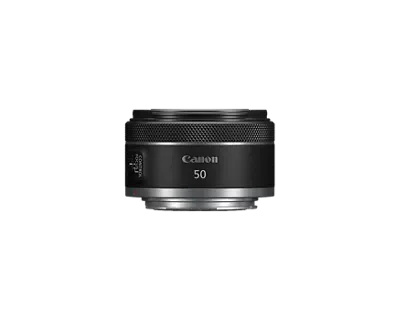
For one fixed view and a wider aperture
Used Canon RF 50mm f/1.8 STM
RF-mount 50mm prime. MPB lists the condition and accessories for each used copy.
- Why choose it
- The 50mm focal length and f/1.8 maximum aperture give you a specific low-light and depth-of-field tool to compare.
- The tradeoff
- It cannot widen or tighten the frame without changing position or cropping. On Canon APS-C it gives an approximately 80mm equivalent view, which is not a general wide-angle option.
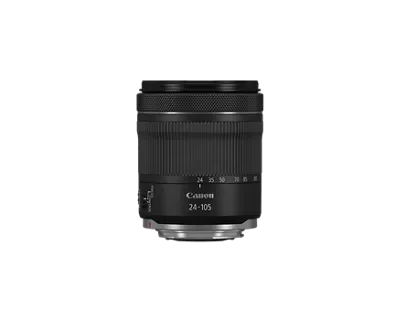
For flexible framing from one position
Used Canon RF 24-105mm f/4-7.1 IS STM
RF-mount full-frame standard zoom with optical stabilization and a variable maximum aperture.
- Why choose it
- The 24-105mm range and optical stabilization cover several ordinary views without a lens change.
- The tradeoff
- Its maximum aperture changes from f/4 to f/7.1 through the range. Stabilization helps with camera movement, not a moving subject, and the used copy still needs a complete condition check.
Product details checked against the linked manufacturer and retailer pages. These are research-based comparisons, not hands-on tests. Check the selected model, current price, availability, and return terms before buying.
Define the choice correctly
A prime lens has one fixed focal length. A zoom lens covers a range of focal lengths. That distinction says nothing by itself about image quality, price, autofocus, stabilization, condition, or whether the lens fits your camera. Compare the exact models and the work they need to perform.
Focal length controls angle of view and subject magnification. A zoom changes that angle of view from the camera position, while a prime asks you to move, crop, or accept a different composition. Moving closer is not always equivalent to zooming because camera position changes perspective and may be impossible at an event, on a trail, or beside a road.
| Question | Prime lens | Zoom lens |
|---|---|---|
| Focal length | One fixed value | A stated range |
| Framing from one position | Move, crop, or keep the fixed view | Turn the zoom ring within its range |
| Maximum aperture | Often wider among modestly priced choices | Varies by model and may change through the range |
| Carry plan | One light lens or several primes | One lens may cover several common views |
| Value test | Does this exact focal length solve the job? | Will you use enough of the range to justify it? |
Start with the photograph you could not make
Write down the last three times your current lens limited a photograph. Separate framing failures from light failures. If the subject was too small or too large and you could not change position, you needed a different angle of view. If motion blurred because the shutter speed was too slow, a wider aperture may have helped. If only your hand movement blurred a stationary scene, stabilization or support may have helped.
This list prevents one attractive specification from answering the wrong problem. A 50mm f/1.8 prime can admit more light than an f/4 to f/7.1 zoom, but it cannot become 24mm for a cramped room or 105mm for a distant detail. A 24-105mm zoom can change framing quickly, but its variable maximum aperture becomes smaller toward the long end.
- Record the subject, distance, light, and failed result.
- Note whether changing position was safe and possible.
- Identify the focal length used when the photo failed.
- Decide whether the missing capability was range, light, focus, or stabilization.
Do not confuse aperture with stabilization
A wider maximum aperture lets more light reach the sensor at the same shutter speed and ISO. It can also produce a shallower depth of field under comparable framing conditions. That can make a modest prime valuable for indoor people, portraits, or other work where subject movement requires a faster shutter speed.
Optical stabilization addresses camera movement during the exposure. It does not freeze a person, animal, or vehicle moving through the frame. The Canon RF 24-105mm example includes optical image stabilization, while the RF 50mm f/1.8 example relies on a wider aperture and can coordinate with supported bodies that have in-body stabilization. Check the exact body-and-lens combination before assigning value to either feature.
Compare the whole range you would carry
One prime can be the smallest solution when its view matches the assignment. Several primes can become heavier, costlier, and slower to change than one zoom. A zoom can replace multiple focal lengths, but carrying unused range or a larger lens is not automatically efficient.
Build two actual bag lists. Include the body, lens or lenses, hood, filters, caps, and any second lens required to cover the missing view. Then compare total weight, delivered price, number of lens changes, and whether every item fits the bag you will use. The correct comparison is one working kit against another, not one prime against every focal length printed on a zoom.
| Plan | What it must cover | Main risk |
|---|---|---|
| One prime | A named focal length and a reason its aperture matters | The fixed view immediately forces another purchase |
| One zoom | The range actually used from the positions available | Aperture, size, or condition undermines the convenience |
| Prime plus kit zoom | Low light plus ordinary flexible framing | Duplicated range without enough added capability |
| Two or more primes | Distinct jobs at each focal length | Cost, weight, and lens changes exceed one suitable zoom |
Use your own focal-length evidence
Review a representative month of photographs from your current zoom or phone. For a camera zoom, sort image metadata by focal length and note how often you use the wide end, long end, and middle. Also mark the pictures that failed, because a successful-file count cannot reveal the shot you skipped when the lens was too slow or the view was wrong.
Treat repeated use at one focal length as a reason to test a prime, not proof that you should buy it. You may have used that value because the zoom stopped there. Borrow, rent, or lock the zoom at the candidate focal length for an ordinary outing. If the fixed view changes how you work in a useful way, you now have stronger evidence than a generic recommendation.
Inspect used primes and zooms differently
Both lens types need checks for glass condition, mount wear, autofocus, aperture operation, filter threads, decentering, and included caps. A zoom adds a moving range to test. Check focus and image consistency at the wide end, middle, and long end, then inspect the zoom ring for binding, excessive play, or movement the listing did not disclose.
If the zoom includes stabilization, test it according to the maker's instructions and compare files with the feature on and off in a suitable stationary scene. For a prime, pay particular attention to focus accuracy at its widest apertures, where shallow depth of field makes small errors easier to see. Neither a clean barrel nor a seller grade replaces full-resolution sample files from the exact copy.
- Confirm mount, sensor coverage, and exact model before condition testing.
- Use a detailed flat subject to compare corners and sides consistently.
- Test every switch, ring, and supported stabilization mode.
- Complete the checks while the written return window remains usable.
Calculate value from avoided purchases
Start with the delivered price and add everything required to make the lens usable. Then subtract value only for another purchase the lens genuinely prevents. A zoom covering 24mm through 105mm does not save the cost of four primes unless you otherwise would have bought and carried those four primes. A 50mm prime does not replace a zoom if you still need wide and long views next week.
For used lenses, include missing caps or hood, immediate service, return shipping exposure, and the time needed to test the individual copy. Compare condition and protection on the same basis. A lower asking price is not a saving when the cheaper lens leaves the original photography problem unsolved.
Finish with one decision sentence
Fill in this sentence: I need a ____ view from a position where I can or cannot move, in ____ light, at a maximum carried weight of ____, and this exact lens solves that job for $____ delivered while leaving ____ uncovered. Write it once for the prime and once for the zoom.
Choose the sentence with the smaller important gap. If both leave a different critical gap, neither is yet the right first purchase. Keep using the current lens until a specific model solves the assignment at a price and condition you can defend.