

Products to compare
The R50 body versus its standard-zoom kit
Keep the camera body constant and compare only what the lens adds to your photographs and checkout total.
Choose the kit when the 18-45mm fills a real gap and its premium is sensible. Choose body only when a suitable lens is already covered or when you have priced a different lens for a specific job.
These links lead to product listings or manufacturer buying options. PriceChomp earns no commission from them. How our links work.
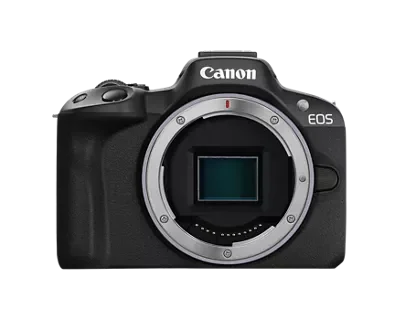
For an existing or separately planned lens
Canon EOS R50, body only
24.2MP APS-C mirrorless camera with Canon RF mount. Select the body-only configuration.
- Why choose it
- Avoids buying another standard zoom when you already have a compatible lens that meets your needs.
- The tradeoff
- A compatible lens can still frame poorly for your subject. Include any adapter, lens, and missing equipment in the complete cart.
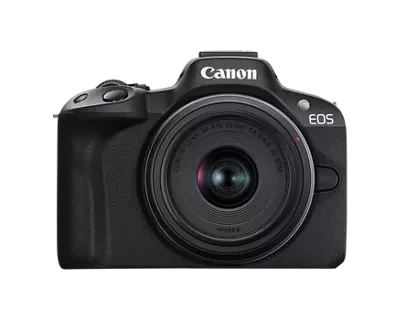
For a first everyday zoom
Canon EOS R50 + RF-S 18-45mm F4.5-6.3 IS STM
24.2MP APS-C sensor; included 18-45mm stabilized zoom.
- Why choose it
- The approximately 29-72mm equivalent view is a concrete range to weigh against the kit premium.
- The tradeoff
- The included lens is not a long telephoto or a bright low-light prime. Do not count a lens you will immediately replace at full standalone value.
Product details checked against the linked manufacturer and retailer pages. These are research-based comparisons, not hands-on tests. Check the selected model, current price, availability, and return terms before buying.
Start with three photographs you want to make
Write down three recurring uses, such as family indoors, travel, field sports, wildlife, portraits, video, or close-up work. Then translate them into focal-length range, light level, focus behavior, size, and stabilization needs. This keeps a low kit price from deciding what belongs in your bag.
A compact zoom can be excellent for learning, daylight travel, and discovering preferred focal lengths. It may be less satisfying for low-light motion, strong background blur, distant subjects, or specialized video. The right comparison is the included lens versus the least expensive lens that meets your actual first need.
Identify the exact kit SKU
Manufacturers and retailers may bundle the same body with different lenses, batteries, memory cards, bags, warranties, or software. Copy the body model, lens model, and full retailer SKU. Check whether the lens is a current version, whether it is sold separately, and whether the package uses a manufacturer kit box or a retailer-created bundle.
Retailer bundles are not inherently worse, but the accessories can be low-value. Memory-card speed, battery authenticity, charger type, bag fit, tripod capacity, and filter quality matter more than item count. Give every component only the value it has to you.
| Cost or value | Body-only cart | Kit cart |
|---|---|---|
| Camera body | $____ | Included |
| First useful lens | $____ | Included or $____ |
| Battery and charger | $____ | $____ |
| Useful accessories | $____ | $____ |
| Items likely to be replaced | List | List |
| Ready-to-shoot total | $____ | $____ |
Give the kit lens credit for being small
A lens does not need a wide aperture or premium construction to be useful. Small size, low weight, quiet focus, close-focusing ability, and a practical zoom range may mean the camera comes along more often. Those are real benefits, particularly for travel and family use.
Also look at what the lens cannot do. Check maximum aperture across the zoom range, weather protection, manual controls, stabilization, focus motor, filter size, and whether the mount has an affordable next lens. A cheap kit can become expensive if it immediately creates two replacement purchases.
Decide with the first year, not an optimistic future sale
A kit lens may retain some secondhand value, but selling takes time, fees, shipping materials, and condition risk. I do not use the highest asking price as a discount against today’s cart. If I expect to sell it, I use a conservative completed-sale value after likely costs.
Choose the kit when the lens will be used, the bundle savings are real against current separate prices, and the warranty and return terms are clear. Choose body only when you already own a compatible lens or have identified a different first lens that better fits the work. The smaller cart is not automatically the cheaper system.