

Products to compare
Two RF lenses with very different fields of view
Both examples are for Canon EOS R bodies. RF in the model name matters: it is not the same mount as EF, EF-S, or EF-M.
Choose the RF50mm for a specific prime-lens job, or the RF 24-105mm for zoom flexibility, only after checking the exact camera. On a Canon APS-C body, multiply focal length by 1.6 to compare field of view with full frame.
These links lead to product listings or manufacturer buying options. PriceChomp earns no commission from them. How our links work.
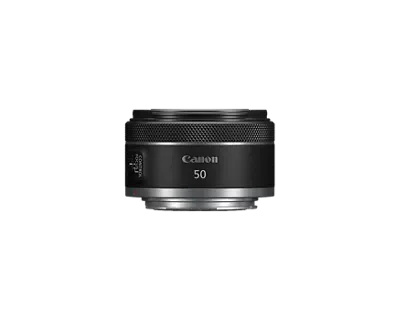
For a fixed focal length and wider aperture
Canon RF50mm F1.8 STM
Canon RF-mount 50mm f/1.8 prime for EOS R cameras; covers full-frame and APS-C sensors.
- Why choose it
- Its RF mount and full-frame coverage make it a candidate for both full-frame and APS-C EOS R bodies.
- The tradeoff
- On an R50 it frames like approximately 80mm on full frame. It is not a wide everyday view or a direct-fit DSLR lens.
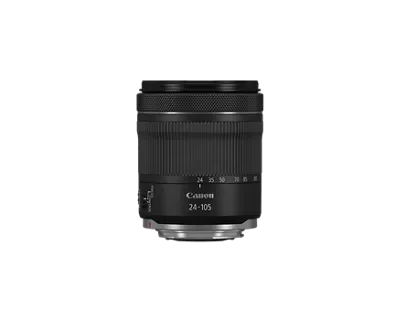
For a range of framing options
Used Canon RF 24-105mm f/4-7.1 IS STM
RF-mount full-frame standard zoom with optical stabilization and a variable maximum aperture.
- Why choose it
- The RF zoom gives you several focal lengths and optical stabilization in one lens.
- The tradeoff
- On an R50 its view is approximately 38-168mm equivalent. Confirm the exact RF version and the used copy's condition.
Product details checked against the linked manufacturer and retailer pages. These are research-based comparisons, not hands-on tests. Check the selected model, current price, availability, and return terms before buying.
Name both mounts before doing anything else
Write down the camera’s exact model and native mount, then the complete lens name and mount version. Manufacturers can maintain DSLR and mirrorless mounts at the same time, sell one optical design in several mounts, or use similar abbreviations for incompatible systems.
A lens that physically clicks into place is not automatically a complete match. Do not force a lens or trust a listing that says only “fits Canon,” “for Sony,” or another brand-level shortcut. Compatibility begins with the precise mount combination.
Check the image circle against the sensor
A lens designed for a smaller sensor may mount on a larger-sensor body but force a crop mode or produce dark corners. A full-frame lens often works on a smaller sensor in the same mount, but its field of view changes. Compare the effective framing you need, not just the focal length printed on the barrel.
Medium-format, full-frame, APS-C, and smaller systems use different image circles and crop conventions. I use the camera and lens manufacturers’ compatibility information first, then confirm any crop or resolution consequence in the camera manual.
| Layer | Question |
|---|---|
| Mechanical | Do the exact mount and physical clearances match? |
| Optical | Does the lens cover the camera sensor as intended? |
| Electronic | Do aperture, focus, metadata, and controls communicate? |
| Performance | Are burst, video, stabilization, and focus modes supported? |
| Support | Are required firmware and adapter versions documented? |
Treat autofocus and stabilization as separate promises
Autofocus may work but lose subject-detection modes, continuous focus speed, focus confirmation, or video smoothness. Aperture control and metadata can also vary. Check the exact lens, body firmware, and adapter combination instead of assuming that one successful pairing proves the entire lens family.
When both body and lens offer stabilization, the system may coordinate them, use only one, or require a menu choice. Older lenses may need firmware service. If a feature matters for paid work or an upcoming trip, look for an explicit compatibility statement rather than a forum inference.
Use adapters to solve a real problem
A simple manual adapter can be a sensible way to use an older lens for deliberate still photography. Electronic adapters add autofocus, aperture control, metadata, or stabilization communication, but performance depends on the exact combination. Some include optics that change focal length or image quality.
Price the adapter, tripod collar, firmware tool, and any loss of weather sealing or service support. If the adapted setup costs nearly as much as a suitable native lens, the native option may be smaller, better supported, and easier to resell. I buy the adapter when it preserves a lens with a clear purpose, not merely because adaptation is possible.