

Products to compare
Two camera kits that make the choice concrete
Start with these two Canon kits if you want a small camera with a standard zoom. They show why the lens and the photographs you want matter as much as sensor size.
For everyday travel and family photos, start with the R50 kit if its delivered price leaves more room for the next lens you actually need. Choose the R8 kit when its wider 24mm view or full-frame lens plan solves a specific problem. Neither kit is a complete wildlife or low-light portrait setup.
These links lead to product listings or manufacturer buying options. PriceChomp earns no commission from them. How our links work.
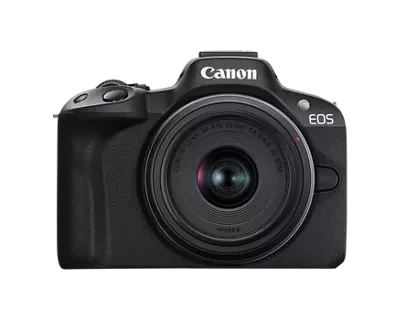
Start here for everyday travel
Canon EOS R50 + RF-S 18-45mm F4.5-6.3 IS STM
24.2MP APS-C sensor; included 18-45mm stabilized zoom.
- Why choose it
- The kit gives you a concrete starting point for a small everyday camera. With Canon's 1.6x crop factor, the lens covers an approximately 29-72mm equivalent view, useful for people and general snapshots.
- The tradeoff
- The 18mm end is not as wide as the R8 kit's 24mm view. Budget for another lens if cramped interiors, distant subjects, or low-light portraits are the main job.
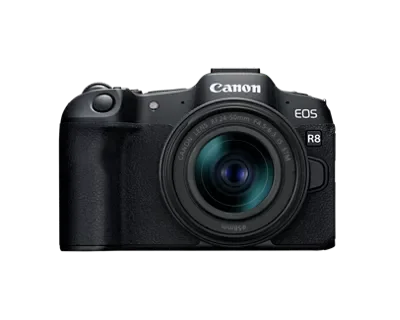
Choose for a wider view and a full-frame lens plan
Canon EOS R8 + RF 24-50mm F4.5-6.3 IS STM
24.2MP full-frame sensor; included 24-50mm stabilized zoom.
- Why choose it
- The 24mm wide end gives you more room for interiors and landscapes than the R50 kit. It is a sensible starting point when you can name the full-frame lenses you will use next and have priced that complete system.
- The tradeoff
- The zoom stops at 50mm and has a modest maximum aperture. Paying for full frame does not turn this kit lens into a long telephoto or a bright portrait lens.
Product details checked against the linked manufacturer and retailer pages. These are research-based comparisons, not hands-on tests. Check the selected model, current price, availability, and return terms before buying.
Translate sensor format into framing first
Full frame describes a sensor roughly the size of a 35mm film frame. APS-C describes a smaller capture area, but the exact dimensions and crop factor vary by camera system. Nikon documents about a 1.5x crop factor for DX, Sony uses about 1.5x for its APS-C cameras, and Canon documents 1.6x for its APS-C EOS systems. Treat those as system-specific examples, then verify the exact camera you are considering.
The focal length printed on a lens does not change when the lens moves between compatible formats. The angle of view changes because the smaller sensor records a narrower portion of the lens image. A 50mm lens on a 1.5x APS-C camera frames approximately like a 75mm lens on full frame. That can be useful for distant subjects, but it can also make a genuinely wide view require a shorter lens.
| Item | What stays the same | What changes |
|---|---|---|
| Printed focal length | The lens remains the stated focal length | The recorded angle of view becomes narrower |
| Camera position | Your distance from the subject can stay fixed | The subject occupies more of the frame |
| Lens image circle | The lens projects the same image | The smaller sensor records less of that image |
| 35mm-equivalent view | A comparison convention only | Multiply by the camera system's crop factor |
Price the matched kit, not two body listings
A fair value comparison gives both systems the lenses needed for the same photographs. If one candidate includes a useful standard zoom and the other requires an additional wide-angle lens, comparing body prices alone hides the real difference. Build each kit from the body, the smallest practical lens set, a working battery and charger, compatible cards, and any required adapter.
Use equivalent framing when selecting lenses. A 16mm lens on a 1.5x APS-C body gives an angle of view near a 24mm lens on full frame. A 35mm lens on that APS-C body is near a 52.5mm full-frame view. These conversions help match the kits, but they do not promise identical image rendering or performance.
- Name the widest and longest views you actually need.
- Price lenses that cover those views in each format.
- Add any adapter, charger, card, spare battery, and missing cap.
- Compare delivered cost only after condition and return terms match.
Check mount and format coverage separately
A shared mount name does not make every lens-and-sensor combination equivalent. First confirm the physical mount and electronic compatibility. Then confirm whether the lens was designed to cover full frame or APS-C. Nikon, Sony, and Canon each document combinations where a full-frame lens can be used on a same-system APS-C body, but the exact restrictions, adapters, autofocus behavior, and crop settings remain model-specific.
An APS-C lens on a full-frame body may trigger a crop mode, record fewer pixels, show dark corners when crop behavior is disabled, or carry other restrictions. Sony and Nikon both document automatic or selectable cropped capture in supported combinations. Canon publishes a matrix across RF, RF-S, EF, EF-S, and EF-M products. Check the maker's exact body, lens, and adapter table instead of applying one brand's rule to another.
| Combination | Likely question | Evidence to verify |
|---|---|---|
| Full-frame lens on full-frame body | Does it cover the full sensor? | Exact mount and compatibility listing |
| Full-frame lens on APS-C body | What narrower view will it give? | Crop factor plus autofocus and stabilization support |
| APS-C lens on APS-C body | Is it native to this mount? | Body, lens, and firmware compatibility |
| APS-C lens on full-frame body | Does the body crop automatically? | Recorded image size, crop setting, and maker restrictions |
Compare the result you need, not a format reputation
A larger sensor creates useful options, but the sensor label does not rank complete cameras. For low light, compare sample files or controlled measurements from the exact models at the ISO values and shutter speeds you expect to use. Sensor generation, resolution, processing, lens aperture, stabilization, and subject movement can matter alongside format.
For portraits or detail isolation, compare the lens and working distance needed for the same framing. Full frame can make a shallower depth of field easier at matched framing and aperture. APS-C can be an advantage when you need more depth of field, a narrower view from an existing compatible lens, or a lighter purpose-built lens. Neither benefit is automatic if the required lens makes the kit impractical.
Video deserves its own row. Readout modes, stabilization crops, recording formats, heat limits, autofocus, and rolling-shutter behavior vary by model. A full-frame badge does not prove that every video mode uses the full sensor, and an APS-C badge does not prove weak video performance.
Run the comparison around one real assignment
Describe one ordinary outing before reading more specifications. Include subject distance, light, final output, how much gear you will carry, and whether you can change lenses. This turns a broad format debate into a short list of body and lens requirements.
| Use case | APS-C may earn its place when | Full frame may earn its place when |
|---|---|---|
| Travel and family | A smaller complete kit gets carried more often | One body covers demanding light with the lenses you already own |
| Wildlife and field sports | Narrower framing reduces the focal length you must buy or carry | High-ISO output and subject separation justify the larger compatible lenses |
| Portraits and events | Cost, reach, and depth of field fit the assignment | Wide views, low light, or shallow depth of field justify the system cost |
| Video | The exact model has the modes, readout, and thermal behavior you need | The exact model uses its larger sensor effectively in those modes |
| Existing lens collection | Compatible lenses already cover your APS-C views | The lenses cover full frame and make the body upgrade economical |
Inspect a used system as one connected purchase
Verify the exact body model, sensor format, mount, region, firmware, and included accessories. Inspect the sensor and mount, test autofocus and aperture control with the intended lens, and review full-resolution files. If the body offers a crop mode, confirm which mode was active when the sample files were recorded so you do not mistake a reduced image for full-sensor output.
Check every lens for format coverage as well as physical condition. A low body price can lose its advantage when the useful lens is missing, an adapter removes features you need, or an APS-C lens forces a full-frame body into reduced capture. Complete the test within the written return window and save the listing, serial numbers, and sample files.
- Test the body with the actual lens or adapter combination you plan to use.
- Confirm image dimensions and crop settings in the recorded files.
- Price missing full-frame or APS-C lenses before accepting the body deal.
- Keep condition, warranty, and return protection comparable across candidates.
Make the decision with one complete sentence
Fill in this sentence for each candidate: for $____ delivered, this body and lens give me a ____ equivalent view, the low-light and depth-of-field result I need, a carry weight of ____, and verified compatibility through ____. The unresolved risk is ____. The format that produces the stronger complete sentence is the better value.
Do not pay for full frame as a future identity, and do not choose APS-C only because the body is cheaper. Buy the smallest complete system that clears the real assignment with acceptable condition, protection, and room for the next lens you can name today.