

Products to compare
A flexible APS-C kit zoom and a wider-aperture 50mm prime
These compatible lenses represent different portrait workflows on an APS-C EOS R body. The MPB link contains individual used RF-S 18-45mm zooms, while the Adorama link is a new RF 50mm f/1.8 prime. The links are uncommissioned. Verify the selected item, condition, contents, price, availability, and current terms.
Choose the RF-S 18-45mm when environmental portraits, groups, or a limited room require several fields of view from one working area. Choose the RF 50mm when its narrower APS-C view fits the session and f/1.8 improves a tested exposure or background result without losing required eyes or faces. Decide from the complete four-portrait audition.
These links lead to product listings or manufacturer buying options. PriceChomp earns no commission from them. How our links work.
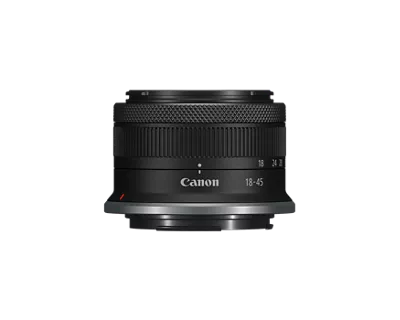
For environmental portraits, groups, and limited rooms
Used Canon RF-S 18-45mm f/4.5-6.3 IS STM
APS-C-focused RF-mount 18-45mm standard zoom with optical stabilization and a variable maximum aperture.
- Why choose it
- Canon specifies an 18-45mm range, optical stabilization, STM focusing, and an approximate 130-gram weight. Test the focal lengths that complete the portrait list from the permitted working positions.
- The tradeoff
- Its maximum aperture changes from f/4.5 to f/6.3, and stabilization cannot stop a moving subject. Inspect autofocus, stabilization, rings, the retracting mechanism, glass, mount, and camera communication on the selected used copy.
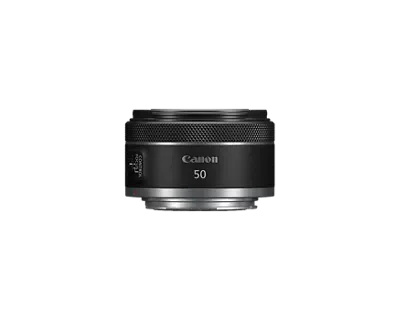
For a tested 50mm view and f/1.8 option
Canon RF50mm F1.8 STM
Canon RF-mount 50mm f/1.8 prime for EOS R cameras; covers full-frame and APS-C sensors.
- Why choose it
- Canon specifies a fixed 50mm focal length, f/1.8 maximum aperture, STM focusing, and approximate 160-gram weight. Test the real working distance, eye focus, depth of field, subject motion, and background at the intended output size.
- The tradeoff
- The fixed view can be too tight for an APS-C room or group, and f/1.8 can leave a turned eye or another person soft. It has no in-lens stabilization specification and cannot reframe without moving, cropping, or changing the pose.
Product details checked against the linked manufacturer and retailer pages. These are research-based comparisons, not hands-on tests. Check the selected model, current price, availability, and return terms before buying.
Define the portraits before choosing the lens
Portrait photography can mean a tight headshot, a half-length portrait, a person inside a room, a full-length environmental frame, or several people together. List the frames you must deliver, the number of people, the locations, and the final output before comparing lenses. A 50mm prime that works well for one face may be too tight for a family in a small room, while a zoom chosen only for flexibility may not deliver the low-light or depth-of-field option that prompted the purchase.
Write the closest and farthest camera positions available at each location. Mark whether you can move, whether the subject can move, and whether a background, light stand, furniture, or public boundary limits the frame. Add the time allowed for each setup. The useful lens is the one that completes the portrait list without inventing space the session does not have.
| Portrait | What must fit | What to test |
|---|---|---|
| Headshot | Face, hair, and intended crop | Working distance, eye focus, and background |
| Half length | Pose, hands, and enough edge room | Framing from the normal camera position |
| Environmental | Person plus meaningful surroundings | Whether the lens can include the location without crowding |
| Small group | Every person and the planned arrangement | Depth of field, edge placement, and room width |
Choose the view from a comfortable working distance
Canon specifies an 18-45mm range for the RF-S zoom and a fixed 50mm focal length for the RF prime. On an APS-C body, the 50mm lens produces a narrower field of view than the zoom at every setting. That can suit a tighter portrait when the photographer has room, but it can prevent a half-length, environmental, or group frame in a constrained location.
Stand where you can communicate naturally with the subject and where the background works. Preview 18mm, 35mm, 45mm, and 50mm where your current equipment permits. Record the frame, camera-to-subject distance, background coverage, and whether the photographer has to move into a doorway, aisle, street, or another unusable position. Do not judge a focal length from a crop made at a distance you cannot maintain during the session.
Hold camera position constant before comparing perspective
Camera position controls the perspective relationship between the subject and background. Focal length controls how much of that view is recorded from that position. Start a fair comparison with the camera and subject on fixed marks, then compare the zoom near its long end with the 50mm prime. Only after that should you move the camera to make matched final framing.
Save both results. The fixed-position pair shows the framing difference. The matched-framing pair shows what happened when camera distance changed. Look at facial proportions, background size, and how much room remains around the pose. This prevents a crop or camera move from being mistakenly credited to the lens alone.
Use aperture to protect the eyes and the pose
Canon specifies an f/1.8 maximum aperture for the 50mm prime and a variable f/4.5-6.3 maximum aperture for the RF-S zoom. A wider aperture can admit more light and reduce depth of field. It can also leave one eye, a turned face, hands, or another person outside the acceptable focus zone. Canon portrait guidance likewise warns that very wide apertures can leave the farther eye soft when a face turns away from the camera.
Test the prime at f/1.8 and at the apertures that keep the required parts of the portrait sharp. Test the zoom at the focal lengths in the portrait list. Hold final framing and output size as consistently as the room permits. Record shutter speed, ISO, focus success, background rendering, and which features remain acceptably sharp. The prime earns its aperture advantage only when the actual portrait survives it.
Treat one person and a group as different assignments
A single subject can often be placed on one focus plane. A group usually includes small differences in distance even when the pose looks orderly. Canon posing guidance recommends accounting for those distance differences with additional depth of field. That can reduce the benefit of buying a lens mainly to use it wide open.
Build the widest group you realistically photograph and mark every face position. Make the frame at the aperture you expect to use, then inspect every face at the delivery size. Repeat with a single subject. If the 50mm prime forces the group too far back or outside the room, the zoom has answered that part of the decision. If the prime fits and every required face is sharp, keep its exposure and background options in the comparison.
Separate subject motion from camera shake
Canon rates the RF-S zoom for four stops of in-lens optical stabilization under its stated test conditions. Stabilization can reduce some blur from camera movement. It cannot hold a child, gesture, expression, walking subject, or moving hair still. A wider aperture can make a faster shutter possible under matched light and ISO, but only if the shallower depth of field remains acceptable.
Run two tests: a still subject and a moving subject. Keep the intended framing, lighting, and output size consistent. For each lens, record shutter speed, ISO, stabilization state, and the percentage of frames with both the intended expression and acceptable focus. This separates a camera-holding problem from a subject-motion problem before either lens is called the low-light winner.
Test focus behavior on the exact camera and subject
Both example lenses use Canon STM focusing systems, but the motor label does not prove how a particular body, lens, firmware version, subject, and light level will perform together. A shallow f/1.8 portrait also gives a focus miss less room to hide than a smaller aperture.
Photograph a face looking at the camera, a face turned slightly away, eyeglasses, backlighting, and a subject walking toward the camera. Confirm the camera mode and selected eye or focus point rather than assuming automation chose correctly. Repeat enough frames to reveal intermittent misses. Review the intended output and the critical eye, not merely the camera preview.
Control the background before buying blur
Background separation comes from more than the aperture number. Subject-to-background distance, camera position, focal length, framing, background detail, and final crop all change the result. A wider aperture cannot remove a bright sign crossing a face or a line that appears to grow from the subject.
Make one portrait at each candidate setup, then move the subject farther from the background without changing the intended framing. Compare both interventions at the final size. Record whether the improvement came from the lens, the distance, the camera position, or a cleaner background choice. The most repeatable background solution may cost nothing.
Count session handling, not only image specifications
A zoom can move from an environmental portrait to a tighter frame without changing lenses or walking as far. A prime fixes one view, which can make the photographer plan positions more deliberately. Either approach can help or interrupt the session depending on the location, subject, pace, and number of requested frames.
Rehearse a short sequence: environmental portrait, half length, headshot, and a two-person frame. Record how often the camera moves, the subject moves, the lens changes, and the background or light must be reset. Include communication and comfort in the notes. A lens that produces a preferred isolated frame but slows every required group setup may be a second lens rather than the only lens.
Price the complete portrait kit
Compare delivered totals for the setup that can make the portraits, not just the lens. Include the hood, caps, filters you truly need, light or reflector, stand, support, spare battery, and any bag change. Price the equipment required to solve the actual limitation rather than assuming the entire budget belongs in glass.
For the used zoom, select the individual copy and save its condition report and included-item list. Inspect the glass, mount, rings, retracting action, autofocus, stabilization, and camera communication while the written remedy remains usable. For the new prime, separate the base lens from optional bundles, protection plans, financing, and promotional extras. Compare complete carts under the current written terms.
Run a four-portrait audition and decide
Make a headshot, half-length portrait, environmental portrait, and small group with each candidate. Use the real room or a location with matching limits. Keep the subject marks, lighting, output ratio, and editing target consistent. Record camera distance, focal length, aperture, shutter speed, ISO, focus success, setup time, and any frame you could not make.
Finish with one sentence: Choose the zoom because ____ required portraits need wider framing or faster reframing inside the available space. Choose the 50mm prime because its tested field of view fits ____, f/1.8 improves ____, and the eyes or group remain sharp at ____. Choose neither when the test reveals that a different focal length, lighting change, or location is the real requirement.