

Products to compare
One matching EOS R50 backup, bought new or selected used
The Adorama link is the new black EOS R50 body-only model 5811C002, while the MPB link contains individual used EOS R50 bodies. The links are uncommissioned. Buy neither until a timed drill proves that a matching second body solves a real interruption risk.
Choose the new path when its current complete cost and protection are worth more than the adjusted saving on the selected used copy. Choose the used path only after that exact SKU passes the full arrival test and readiness drill. In either case, the second body must be independently powered, carry qualified media, have an assigned compatible lens, and produce a usable frame inside the required switchover time.
These links lead to product listings or manufacturer buying options. PriceChomp earns no commission from them. How our links work.
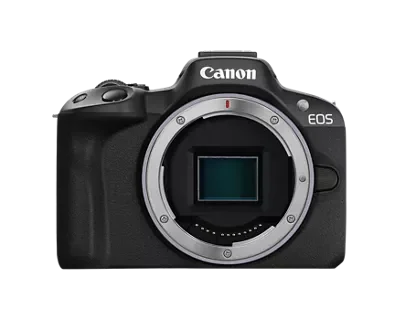
The matching new-body path
New Canon EOS R50 body at Adorama
Black EOS R50 body-only configuration; Canon manufacturer number 5811C002. Verify current cart contents and terms.
- Why choose it
- Adorama identifies the exact black body-only model, while Canon supplies the specifications, box-content reference, support notices, firmware, and manuals needed to build and verify a matching backup workflow.
- The tradeoff
- A new body still needs its own ready power, qualified card, assigned lens, configuration review, and failure drill. Optional bundles and protection can distort the base comparison, and the product page is not proof of current stock.
The unit-specific used path
Used Canon EOS R50 at MPB
R50 body listings with individual condition reports, photographs, and included-item lists.
- Why choose it
- MPB lists individual R50 bodies with copy-specific condition, photographs, included items, and other unit details when supplied. One selected copy can be evaluated as a lower-cost matching backup.
- The tradeoff
- The model-page starting price and grade are not the exact backup. Missing equipment, unit condition, return exposure, testing time, or an incomplete drill can erase the apparent saving.
Product details checked against the linked manufacturer and retailer pages. These are research-based comparisons, not hands-on tests. Check the selected model, current price, availability, and return terms before buying.
Name the loss a second body must prevent
A second body is not automatically insurance. Write the photograph, recording, deadline, or client obligation that would be lost if the main camera stopped working. Then write how long you could pause, whether the moment can be repeated, and what a missed result would actually cost. A wedding ceremony, school performance, or short wildlife opportunity creates a different risk from a casual walk that can be rescheduled.
Use a second body only for a failure it can solve. It does not replace spare power, working media, a compatible lens, weather protection, data backup, or practiced controls. If the likely interruption is a dead battery or full card, another camera body is an expensive answer to a cheaper preparation problem.
| Question | Evidence to record | What it changes |
|---|---|---|
| What cannot be repeated? | Exact event, shot, or delivery | Sets the consequence of failure |
| How long can shooting stop? | Maximum acceptable interruption | Sets the required switchover time |
| Which failure is plausible? | Body, battery, card, lens, settings, or access | Shows whether another body solves it |
| What alternative exists? | Rental, loan, second photographer, or reschedule | Creates a real no-purchase comparison |
Separate body failure from the rest of the camera system
List the breakdowns that have actually interrupted your shooting. Include an empty battery, card error, damaged lens, loose cable, wrong exposure mode, overheated accessory, missing release plate, forgotten charger, or a camera body that will not operate. Mark which problems a second body would solve immediately and which would follow you to the backup.
A backup body with no charged battery, compatible card, working lens, strap, or prepared settings is inventory, not readiness. If both bodies depend on the same single lens and that lens fails, the second body does not restore the system. Build the remedy around the whole failure path instead of assuming the most expensive component is the weak point.
Understand what one card slot does and does not mean
Canon specifies one UHS-I compatible SD card slot for the EOS R50. A second matching R50 gives you another camera and another card slot, but it does not create simultaneous duplicate recording inside either body. Files remain separate unless your workflow deliberately copies or rotates them.
Decide how cards will be assigned, labeled, formatted, changed, and protected before the event. Use cards that meet the exact recording mode, verify them in each body, and keep exposed media physically separate from blank media. A second camera reduces some interruption risk only when its own card is installed, tested, and ready.
Measure the lens-change problem instead of imagining it
A second body can keep two lenses ready, which may reduce changes in dust, rain, crowds, or fast sequences. Test that benefit with the actual lenses and carrying method. Time how long it takes to switch a lens safely, then time how long it takes to reach, wake, and confirm the second body. Count missed frames, blocked movement, bag openings, and mistakes.
Two bodies also add weight, straps, batteries, cards, clocks, settings, and places to put the wrong lens. If the second camera stays in a closed bag, it may be slower than one practiced lens change. The advantage must survive a realistic walk, room, crowd, or working position.
Choose matching controls or accept a complementary system
Matching bodies can reduce control, menu, battery, lens-mount, and file-handling differences. Canon identifies the EOS R50 as an RF-mount APS-C body using the LP-E17 battery and one SD card slot. If the main camera is also an R50, a second R50 can make the transition simpler, but only after both are configured and tested the same way.
A different body can add a useful capability or serve another lens, but every difference becomes a handoff question. Check mount and lens behavior, battery and charger, card type, button layout, autofocus setup, file size, color workflow, ports, accessories, and support. A complementary body earns its complexity only when the extra capability matters more than a matching operating routine.
Price the complete ready-to-shoot duplicate
Start with the body, then add every item needed to make it independently usable: compatible lens or assigned lens, charged battery, charger access, qualified card, strap or carry attachment, body cap, weather protection, support plate, cable, microphone or flash interface if required, and a bag position you can reach. Credit shared gear only when both bodies will not need it at the same time.
Add preparation and maintenance too. Two bodies require firmware review, clock checks, settings review, sensor and mount inspection, battery rotation, card formatting, file-numbering discipline, and a storage plan. The second body is worthwhile only when the complete system cost is lower than the risk or interruption it prevents.
Compare one new cart with one exact used copy
The Adorama page identifies the black EOS R50 body-only configuration as Canon model 5811C002. The MPB page groups individual used EOS R50 bodies with copy-specific condition, photographs, included items, and other unit details when supplied. Hold the model and body-only configuration constant, then compare one current new cart with one exact used SKU.
Do not use a model-page starting price, cosmetic grade, promotional bundle, or optional protection plan as the final comparison. Record delivered total, included battery and charger, covers, condition evidence, return exposure, written protection, and the time available for an arrival test. Publish no stock or price assumption into the decision because those facts can change after review.
Make the two bodies behave predictably
Set both bodies beside each other and review date and time, time zone, file format, image quality, autofocus behavior, exposure controls, stabilization choices, display information, wireless settings, custom controls, and power-saving behavior. Save a short configuration record that can be checked again before a job. Do not assume a copied menu choice is correct for every lens or assignment.
Use distinct body labels and card labels so files and batteries can be traced. Choose a file-numbering and import routine that prevents silent overwrites or mistaken grouping. Synchronize clocks closely enough for the editing workflow you use, then make a test sequence on both bodies and confirm the files arrive in the intended order.
Run a timed failure drill before trusting the backup
Build the actual working setup, start a representative sequence, and have another person call a body failure at an unknown time. Stop using the main body. Move to the backup without borrowing the failed body's battery, card, or essential accessory. Record the time to the first technically usable frame and every decision that slowed the transition.
Repeat with the main lens unavailable, a card that must be isolated, and the second body stored where you intend to carry it. Review focus, exposure, file format, clock, card destination, and image quality after every drill. A body that works on a desk may still fail the operational requirement because it is inaccessible, configured differently, or missing one shared component.
| Test | Pass evidence | Failure to fix |
|---|---|---|
| Main body stops | Usable backup frame inside the required time | Access, power, card, lens, or control delay |
| Main lens unavailable | A planned alternate frame remains possible | Both bodies depend on one essential lens |
| Files imported together | No overwrite, clock confusion, or missing card | Labeling and file workflow are incomplete |
| Long carry period | Both bodies stay secure and reachable | Theoretical speed disappears in real handling |
Inspect and test the exact body during the remedy window
For either purchase path, verify the model, serial, included items, battery and charger, card writing and playback, controls, screen, viewfinder, autofocus, stills, video, ports, hot shoe or microphone input if needed, wireless connection if needed, and repeated operation. Inspect files on a larger display. Check Canon's support page for current manuals, firmware, and service notices that apply to the body.
For a used copy, preserve the unit listing, photographs, stated condition, included-item record, and written terms. Do not convert a shutter count or clean exterior into a remaining-life promise. For a new cart, confirm the exact body-only line item and current retailer terms. Stop and document a problem instead of attempting a repair that could complicate the available remedy.
Compare renting, borrowing, and one-body preparation
Price a rental for the dates that truly need redundancy, including pickup, shipping, deposit, insurance decision, learning time, and return schedule. A known compatible loan can also work when its availability and condition are confirmed. For infrequent critical events, these paths may cost less than owning, maintaining, and periodically testing another body.
Also price the strongest one-body plan: fresh qualified cards, enough tested batteries, charger access, firmware review, a pre-event inspection, an emergency rental source, and a second photographer when the event justifies one. Choose the plan that meets the interruption requirement, not the plan that puts the most equipment in the bag.
Make the purchase decision from the drill result
Write one sentence before buying: Purchase the second body because it protects ____ and the drill shows a switchover of ____ within the required ____; its complete cost is ____ compared with ____. Do not buy because the likely failures are better solved by ____ and a rental or one-body plan covers the remaining risk.
If a second R50 is justified, decide between the exact new cart and exact used copy only after both are normalized for contents, protection, testing time, and delivered cost. Choose neither if the body will not be carried ready, the workflow still depends on one essential item, or the drill does not meet the deadline.