

Products to compare
Two generators to test against a written load plan
These are sizing examples, not a promise that either will power your home. Use running demand, motor startup demand, voltage, and the fuel you intend to use.
Consider the 201183 only for a load plan within its 120V and fuel-specific limits. Consider the 201176 when a verified plan needs more capacity or 240V. Operate outdoors well away from openings, and use a qualified electrician for a home-circuit connection.
These links lead to product listings or manufacturer buying options. PriceChomp earns no commission from them. How our links work.
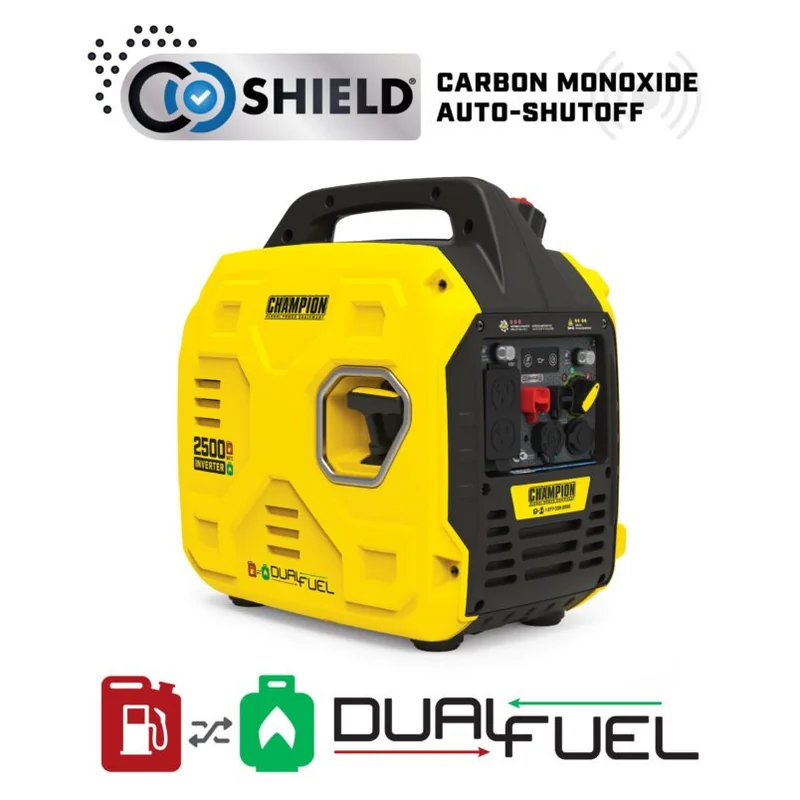
For a small 120V load plan
Champion 201183 dual-fuel inverter
120V output; 1850 running watts on gasoline or 1665 on propane. 2500 starting watts.
- Why choose it
- Its fuel-specific running ratings prevent the 2500W headline from becoming an assumed continuous allowance.
- The tradeoff
- It cannot supply 240V loads. Starting watts are temporary, and carbon-monoxide shutoff does not make indoor or garage operation safe.
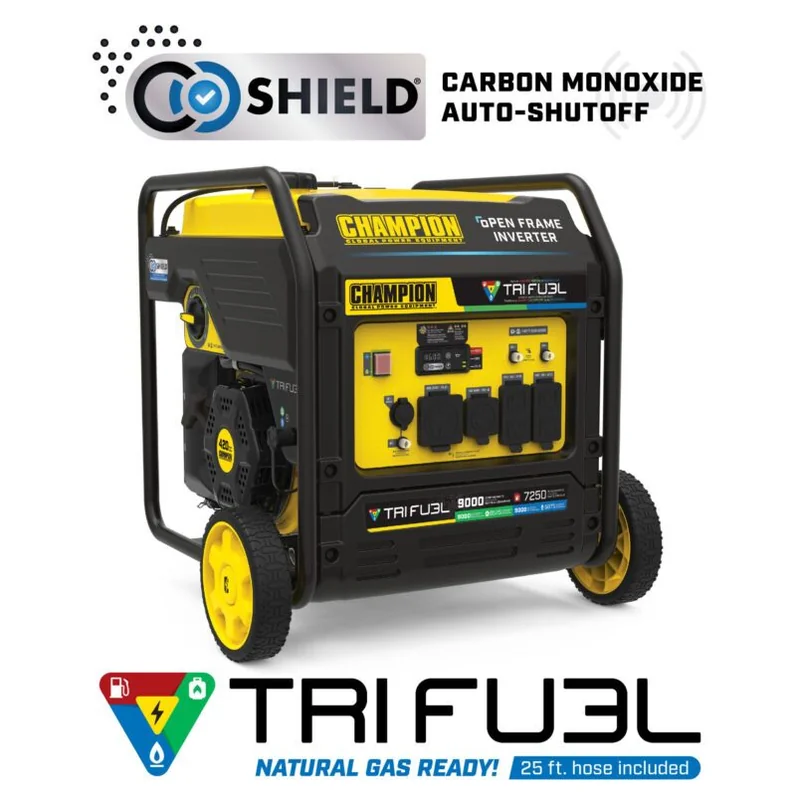
For a larger, verified load plan
Champion 201176 tri-fuel inverter
120/240V output; running watts: 7250 gasoline, 6525 propane, or 5875 natural gas. 9000 starting watts.
- Why choose it
- The 120/240V output and three different running ratings let you size around the actual fuel and connection.
- The tradeoff
- Do not use 9000W as a continuous budget. Installation, fuel supply, weight, and storage can dominate the project cost.
Product details checked against the linked manufacturer and retailer pages. These are research-based comparisons, not hands-on tests. Check the selected model, current price, availability, and return terms before buying.
Start with an outage plan, not a generator size
Write down what must run, what would be merely convenient, and what can take turns. Refrigeration, selected lighting, communications, medical needs, water systems, heating controls, and cooking equipment can have very different priorities. A smaller generator can support a thoughtful rotation plan, while an oversized generator may consume more fuel and be harder to move.
Use labels, manuals, manufacturer data, or measured consumption for the exact equipment. Generic wattage charts are only rough planning tools. Motors, compressors, pumps, and some power supplies can draw substantially more during startup than they use after settling.
Calculate simultaneous running load
Group the devices that may operate at the same time and total their running watts. Include the generator accessories and connection equipment required by your plan. Leave operating margin instead of designing a system that depends on the generator remaining at its maximum rating continuously.
Then test startup cases. The relevant scenario is usually the normal running total plus the temporary startup requirement of the largest motor that might start. If two automatic devices can start together, plan for that possibility or establish a manual operating sequence.
| Device | Running watts | Extra startup watts | Must run together? |
|---|---|---|---|
| Refrigerator or freezer | Use exact evidence | Check compressor startup | Often |
| Well or sump pump | Use exact evidence | Often significant | Situation dependent |
| Lights and communications | Total selected devices | Usually limited | Often |
| Cooking or heating appliance | Use exact evidence | Model dependent | Can often be scheduled |
Distinguish rated output from peak output
Manufacturers may emphasize a larger starting, surge, or peak number. That temporary rating is not the amount available for continuous use. Compare generators first on rated running output under the fuel you intend to use, then confirm the documented surge capability fits your startup case.
Dual-fuel and tri-fuel machines can have different output ratings on gasoline, propane, and natural gas. Use the rating for the actual fuel. Also inspect outlet types, per-outlet limits, voltage support, breaker arrangement, and whether the machine provides the connection your approved power plan requires.
Plan fuel before buying capacity
Runtime claims are tied to a stated load and fuel quantity. Estimate fuel consumption at a load resembling your plan, then consider safe storage limits, local availability during an outage, maintenance, and how long you need to bridge. A high-output generator operated lightly may not be the most fuel-efficient way to cover essential loads.
Gasoline, propane, and natural gas each change storage, availability, maintenance, and output tradeoffs. Do not assume one fuel is universally best. Choose a strategy you can safely maintain and test, and follow every manufacturer and local requirement for fuel handling.
Treat connection and carbon monoxide safety as core specifications
Portable generators produce carbon monoxide and must never operate inside a home, garage, shed, basement, or other enclosed area. Follow the manufacturer placement instructions and current public-safety guidance. Exhaust direction, weather protection, extension-cord routing, theft prevention, and noise all need a plan before an outage.
Never improvise a connection to household wiring. Powering home circuits requires approved equipment and qualified installation appropriate to the property and local rules. If you plan to use extension cords, verify that they are suitable for the load, environment, length, and generator outlets.
Test the complete plan under controlled conditions
After reading the manuals, test startup, connection, load sequencing, refueling procedure, and shutdown before the equipment is needed. Confirm that household members understand the safety boundaries. Record the maintenance schedule and keep the required oil, approved cords, and other supplies together.
The best generator is not the largest affordable one. It is the smallest model that safely supports the defined simultaneous load and startup case, uses fuel at a rate you can sustain, and fits a connection plan you can operate correctly.