

Products to compare
Almost matching codes, visibly different finishes
GDF535PSRSS and GDF535PGRWW share a GE dishwasher family, but the full codes identify different finishes. Do not shorten them when comparing quotes or ordering parts.
If either finish works, compare exact specifications and complete installed totals. Do not assume a changed suffix always means only color on another appliance family.
These links lead to product listings or manufacturer buying options. PriceChomp earns no commission from them. How our links work.
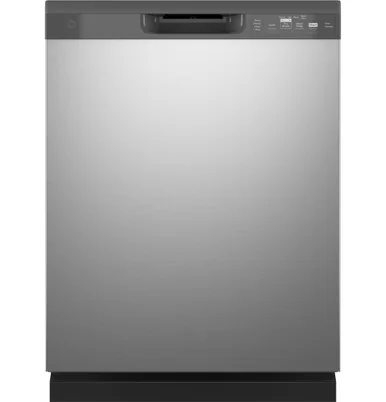
Record GDF535PSRSS in full
GE GDF535PSRSS dishwasher
Built-in dishwasher with front controls and stainless-steel exterior; nominal 24-inch installation class.
- Why choose it
- The product page identifies the stainless-steel version, giving you an exact model to match to the quote and delivery carton.
- The tradeoff
- Do not substitute a similar-looking retailer code without checking the features, dimensions, included connections, and warranty.
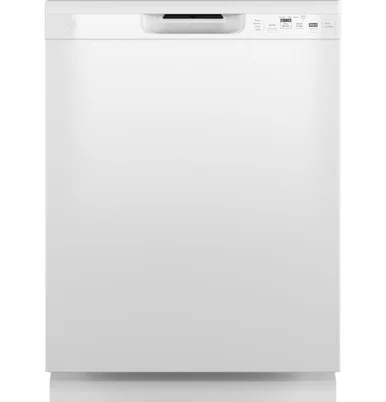
Record GDF535PGRWW in full
GE GDF535PGRWW dishwasher
Built-in dishwasher with front controls and white exterior; listed width 23.75 inches for a 24-inch cutout.
- Why choose it
- The white version is a concrete example of why a common model stem is not enough for an identical-product comparison.
- The tradeoff
- A finish difference does not prove that every specification or offer term matches. Read both installation documents before ordering.
Product details checked against the linked manufacturer and retailer pages. These are research-based comparisons, not hands-on tests. Check the selected model, current price, availability, and return terms before buying.
Copy every character in the model code
Record the complete model number from each live listing, including trailing letters, color codes, package suffixes, and revision identifiers. Search that complete code on the manufacturer support site and open the specification sheet, installation instructions, energy information, warranty, and parts diagram when available.
A retailer-specific suffix may indicate only finish or packaging, but it can also accompany a different rack, handle, dispenser, accessory, connected feature, warranty bundle, or production revision. Similar marketing names are not proof of equivalence.
Compare the dimensions that affect use
Nominal width is a shopping category, not an installation measurement. Compare cabinet dimensions, overall depth with and without handles, door-open depth, hinge clearance, leveling range, ventilation gaps, and the route required for plumbing, power, gas, or exhaust.
For refrigerators, check whether doors and drawers open fully beside a wall or island. For laundry, include hose, vent, lid, and door clearance. For dishwashers and ranges, inspect counter, flooring, anti-tip, junction, and trim requirements. A one-inch feature difference can create a much larger carpentry problem.
| Compare | Evidence to use |
|---|---|
| Identity and revision | Full manufacturer model code |
| Fit and clearance | Current installation document |
| Core function | Manufacturer specification sheet |
| Included pieces | Package contents and parts list |
| Efficiency | Current official energy label where applicable |
| Coverage | Written warranty for the exact model and region |
Separate useful features from showroom features
Make a short list of jobs the appliance must perform every week. Capacity should be translated into the cookware, dishes, groceries, or laundry loads you actually use. Connected controls, specialty cycles, cameras, extra dispensers, convertible zones, and premium finishes belong in the comparison only when they change a recurring task.
Also ask what the feature adds: filters, proprietary consumables, cleaning steps, seals, motors, water connections, software dependence, or repair complexity. A feature can be genuinely useful and still carry an ownership cost worth knowing.
Make the final choice from two complete files
For each candidate, keep the live price, product page, model-specific documents, ready-to-use cost, return terms, and warranty together. Note any uncertain difference rather than assuming the cheaper listing is a harmless store variant. If the manufacturer cannot confirm equivalence, compare the appliances as different products.
My final sentence names the practical win: “Model A fits the opening, clears the island, handles our common load, and costs $___ installed with the coverage we need.” If the sentence depends on a badge, a finish name, or an unverified near-match, I keep comparing.